






Energy Independence and Hybrid Power Mode
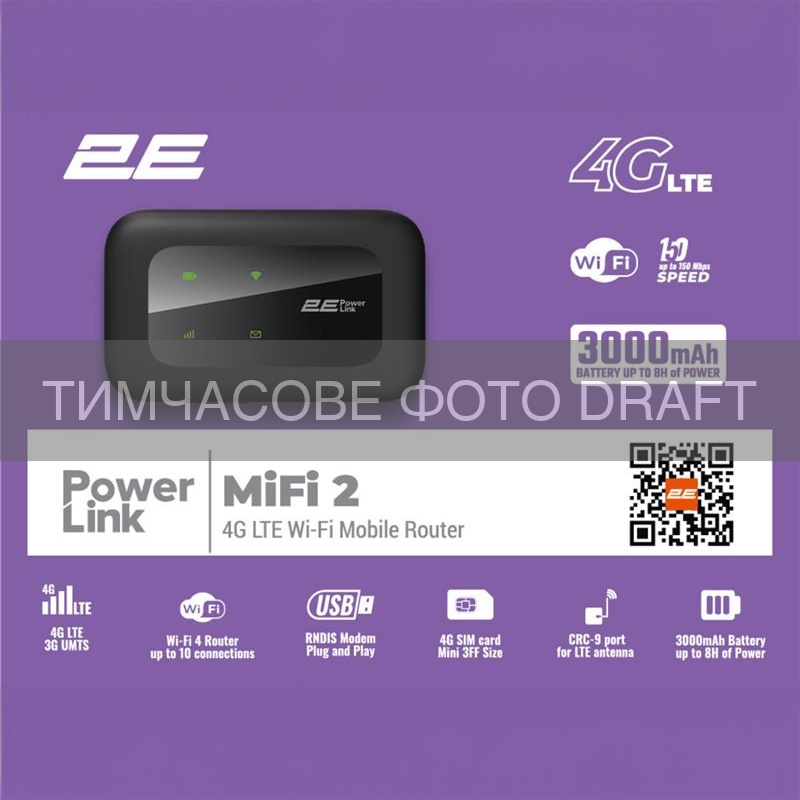
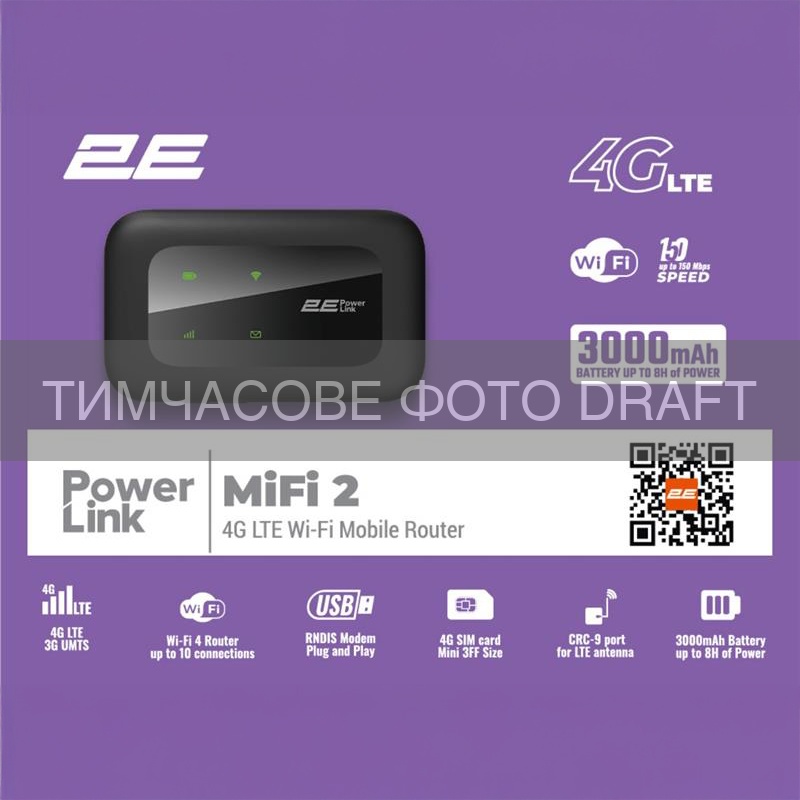
A key advantage of the 2E PowerLink MiFi-2 mobile router is its powerful removable 3,000 mAh battery. It provides up to 8 hours of operation without connecting to a power source, making it ideal for travel, business trips, or outdoor activities. One of the model's key engineering features is the direct power mode. Unlike standard MiFi devices, the MiFi-2 2025 can operate without the battery when connected to a 5 V/1 A power source via the Type-C interface, including a power bank or car charger. This prevents degradation and swelling of the removable Li-Ion battery during extended use in stationary mode. This greatly expands the ways the mobile router can be used without relying on stationary power sources. Perfect for setting up a backup channel at home or in the office.
Radio Section and DRX (Diversity Receiving) Technology
The 2E PowerLink MiFi-2 is based on the energy-efficient ZX297520V3 LTE modem and AIC8800DW Wi-Fi chip. Thanks to LTE Cat.4, the router supports maximum download speeds of up to 150 Mbps and upload speeds up to 50 Mbps – making it ideal for high-quality video streaming, online gaming, video calls, or working with large files. The device implements a Plug & Play concept at the network operator level. The updated configuration database automatically detects APN (Access Point Name) settings without manual configuration – simply insert a SIM card from any Ukrainian or European operator, and the Internet connection is established within a minute after powering on.
The device supports Ukrainian frequency bands FDD (B1/3/7/8/20) and TDD (B38/40/41). This ensures functionality both in high-speed urban networks (1,800/2,600 MHz) and in rural areas (800/900 MHz). For stable connectivity in dense buildings or at the edge of coverage zones, DRX technology is applied. The additional diversity antenna allows the device to analyze reflected radio waves, minimizing multipath fading effects. The system with two internal LTE antennas operates in a “diversity receiving” mode: the device simultaneously analyzes multiple data streams and combines them into the cleanest possible signal, significantly reducing errors (BER) and increasing actual data transfer speeds.
Networking Features and Web UI Control
The router comes with a flexible set of tools for configuring the local network via a web interface.
- Wi-Fi Settings: operates in the 2.4 GHz band (Wi-Fi 4 standard) with up to 10 simultaneous connections. The signal range reaches 15 m in line-of-sight. Transmitter power can be adjusted (Low/Medium/High) for maximum energy efficiency.
- Operating Modes: besides the standard router mode, the device supports Wi-Fi repeater functionality, allowing coverage extension of existing networks without a SIM card.
- Security and Control:
- parental control for limiting access by time;
- access management through “White” and “Black” MAC address lists;
- the ability to create a separate guest SSID to isolate visitor traffic;
- physical WPS button for fast and secure device connection without entering a password.
- Advanced Firewall: for advanced users, professional network firewall settings are available:
- port filtering and mapping;
- port forwarding;
- UPnP and DMZ support for proper operation of online games, servers, and surveillance systems.
- RNDIS Mode: connects to a PC as a virtual network adapter via USB-C. RNDIS mode requires pre-installed drivers stored in the router’s memory.
- Band Locking: forces the device to operate on a specific frequency (e.g., B8 or B20) to stabilize connectivity in remote areas.
External Antennas – Better Signal, More Coverage
For operation in weak signal areas, a built-in CRC-9 port is provided for connecting an external LTE antenna. The kit includes a basic 3 dB antenna. For stable connectivity at distances of 10–15 km from the base station, high-gain directional antennas (e.g., yagi or panel antennas) are recommended. When building such a system, it is crucial to use high-quality CRC-9 pigtails with secure connections and a low-resistance coaxial cable (50 Ohm). To minimize signal loss, the feeder cable length should not exceed 10 m, and antenna alignment should be done using specialized software (e.g., CellMapper) for precise aiming at the operator tower. This setup enhances signal reception and improves network stability.
Design and Ergonomics
Thanks to its compact size (97.5 × 58.5 × 15.3 mm) and light weight of just 95 g, the router easily fits in a pocket or bag. The sleek black matte body is complemented by a mirrored front panel. Smart LED indicators (mobile network, Wi-Fi, SMS, battery) automatically dim in “sleep” mode, saving power and avoiding unwanted light at night.

